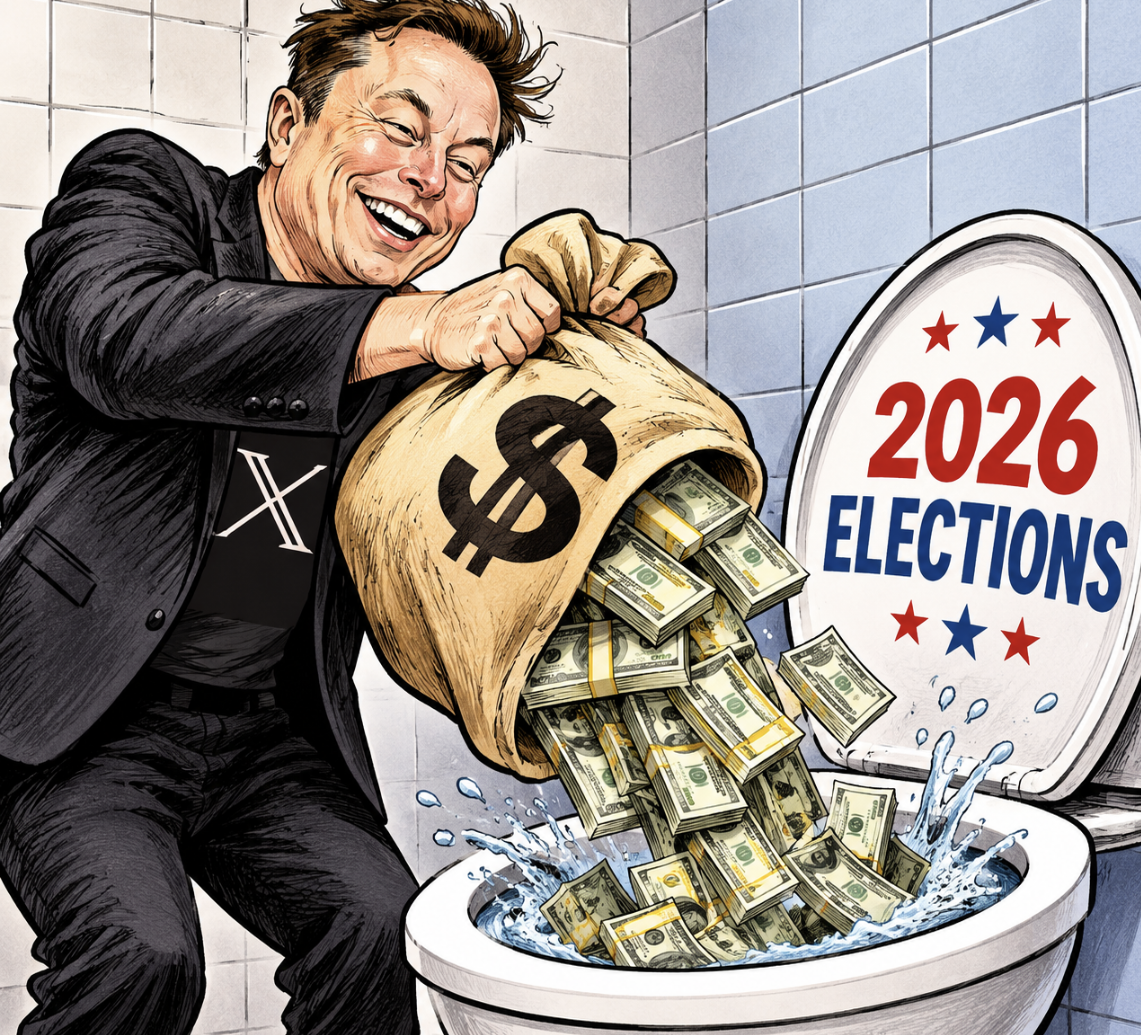
Elon Musk poured almost $500 million into the 2026 midterm elections. Overall, his candidates were not particularly successful, although he did manage to produce a considerable number of second-place finishes. In Texas alone, Musk reportedly spent close to $200 million trying to help Ken Paxton in the Texas Senate race. Unfortunately for Musk, that effort resulted in yet another second-place finish.
As we recall, the Supreme Court’s 2010 Citizens United decision opened the door for corporations and labor unions to spend unlimited amounts of money on political campaigns through super PACs. The decision ushered in what might be called the “Age of Money in Politics.” In the 2026 midterm elections, total spending by both parties approached $12 billion. Of that amount, nearly 80% reportedly went toward television advertising, with Republicans spending approximately 60% more than Democrats.
So, why weren’t Republicans more successful at the ballot box?
Yes, you can argue, and I would agree, that the election results were primarily a repudiation of the Trump administration and its policies. But I’d also like to suggest another contributing factor: the enormous sums being spent on television advertising may be producing diminishing returns. In fact, the traditional television advertising model may be losing its ability to reach the voters campaigns are trying so hard to influence.
Consider my own television-watching habits. If I were the target audience for these political commercials, I’m not sure how advertisers would reach me. When I watch traditional television or cable, I record virtually everything on my DVR and fast-forward through the commercials. Much of my entertainment viewing has also shifted to streaming services, where I watch series and movies on my own schedule. Only a handful of these services carry advertising, and I honestly cannot remember seeing a political commercial on any of them during recent election cycles. On top of that, a fair amount of the time I once spent watching television is now spent on various social media platforms. These are places where I choose what to watch, when to watch it, and how much time to spend there. Traditional television advertising simply isn’t reaching me the way it once did.
The days when 25 million households, or 50 million people, tuned in to watch Cheers at 9 p.m. on Thursday night are long gone. Today’s viewers are scattered across hundreds of television channels, streaming services, and social media platforms. They consume entertainment and information on their own schedules, not according to a network’s programming lineup.
That fragmentation presents a serious problem for political advertisers. The mass audiences that once made television commercials such an effective way to reach millions of voters are becoming increasingly difficult to find. Campaigns can spend hundreds of millions of dollars buying television time, but that doesn’t necessarily mean their intended audience is actually watching those commercials.
Here’s the irony: Citizens United gave an enormous advantage to candidates backed by wealthy donors and special interests. Those opposed to the growing influence of money in politics have spent many years trying unsuccessfully to reverse that decision. But the good guys just might be winning the battle anyway….by default — one fast-forward button, streaming subscription, and social media post at a time.


0 Responses to “MONEY TALKS….but not too loudly anymore”