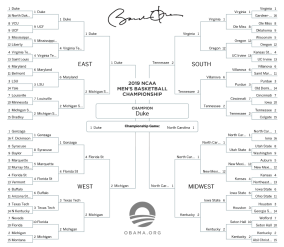
This March Madness is going to my head. But it has very little to do with basketball and everything to do with politics, especially with Democratic Party politics as the presidential race heats up. Every other day, a new Democratic contender throws his or her hat into the ring. As of today, I count 15 Democrats that have announced their candidacy for the 2020 Democratic presidential nomination, and that list does not yet include Joe Biden, Gavin Newsom, Sherrod Brown, Gerry Brown or Adam Schiff. We could very possibly see 24 total candidates after Dennis Kucinich and Carolyn Kennedy enter the fray.
I would hate to see the Democrats repeat the same mistake as the Republicans did in 2016 and let all the candidates run at the same. Having 12 candidates on the stage at the same time was ludicrous as it gave everyone about 10 minutes to speak during two hour debate. It was also farcical to have a minor league debate followed by the major league debate. But the biggest tragedy of the Republican primary process was that it allowed someone with only 35% of the party’s vote to capture the nomination as the other 65% of the Republican vote was split between the other 10 candidates.
I do NOT want to see the Democrats commit the same mistake. Therefore, I have come up with a completely new and revolutionary idea for the primaries inspired by, yes, March Madness. Here is my Primary Madness proposal: We pit only two candidates against each other at a time. This pairing will be made randomly with candidates drawing match-ups from a hat. So say by the draw, Elizabeth Warren is matched against Corey Booker. For the first two weeks only these two candidates campaign, making tours, going on TV, doing newspaper and magazine interviews and finally culminate in a one-on-one debate. The next day, there is a national online primary election, and the winner is decided while the loser graciously steps out. During the next two-week period, say Kamala Harris takes on Joe Biden. The two-week campaign continues, and after the debate, the online votes are cast with only the winner moving on. This will allow candidates to have maximum exposure for a short period of time and remove candidates who cannot out-poll one other candidate. Only winners move on.
So how long will this process take? With 24 candidates, we have 12 pairings. During the first round, if each pair has 2 weeks in the limelight that is 24 weeks, or 6 months. So if we start July 1, 2019, we can finish by the end of the year.
For the second round, we have 12 candidates or six pairs. So again, if each pair has two weeks to campaign, this round will consume 12 weeks, or 3 months, which brings us to April 1, 2020. In the third round, there will be three candidates who will campaign and compete for the month of April culminating in a debate between the three and a vote at the end of the month. This process is repeated for the other three candidates for the month of May. That leaves two remaining candidates that battle it out for the month of June with 3 debates and a vote in the end of June with the final Democratic candidate selected and ready for the convention in the month of July 2020.
This plan is clean and very simple and dare I say…fun
. I tried to work in the “super delegates,” but unfortunately I could not squeeze them in. This plan has been endorsed by Barack Obama. You can see his signature and seal on my bracket parings in the chart above. And finally, the winner of this contest has agreed to accept dinner at the White House.
 H O W A R D S B E N D
0 Responses to “PRIMARY MADNESS”